A garden for children – how do you create a space for safe outdoor play?

A garden for children? Imagine a garden where children’s laughter mingles with the rustle of leaves and their very own play area invites them to climb, slide and chase each other without a care. A garden like this gives children joy and a sense of freedom. It also brings them closer together, fires their imagination and encourages them to stay active. And all without stepping outside the garden gate.
See how to design a garden for children of all ages. Make it safe, practical and full of things they’ll still want to do after the first season.
A children’s garden works well when the entire play area is visible from the house. From the kitchen, living room or patio you should be able to see the whole area, including the access to the slide and the arc of the swing. Younger children need constant supervision. If the play area is behind the garage or at the far end of the plot, an adult has to go outside every time the child wants to play. The child can then use it only when an adult has time. For the same reason, there should be a clear barrier wherever the play area borders a driveway, gate, pond or flight of steps. A running child can reach any of these before an adult has time to react. When designing garden structures, we measure the site, its gradients and sightlines. We use a drawing of the site and its views to locate the play area in relation to the house, instead of simply using whichever space is left.
Contents
Is it worth designing a garden with children in mind?
Absolutely. Children love being outdoors – jumping about on the grass, climbing, building dens and hiding behind bushes. A garden play area of their own lets them do all this safely, under the watchful eye of an adult. It gives them the freedom and space that neighbourhood playgrounds often lack.
Playing in the garden also develops children’s creativity and coordination and nurtures their natural urge to move. And a well-planned garden can grow with your child, changing from a toddler’s corner into a play area with more of a challenge for older children.
How do you design a garden for children? 5 essentials for a safe and inviting space
Every garden can have a rhythm of its own if you plan the space well.
1. A play area to suit your child’s age
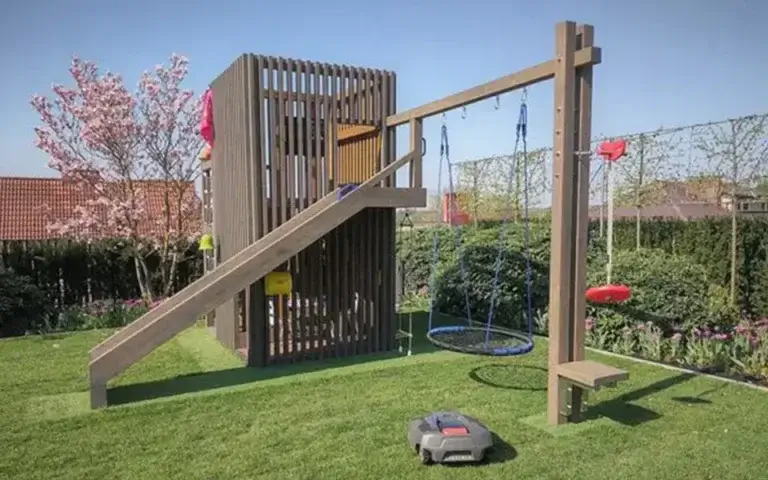
Forget the ready-made set in the catalogue. What matters is a place children can call their own. A play area in the garden can be as simple as a swing hanging from the branch of an old tree or as elaborate as a playhouse with a turret and climbing ropes.
For the youngest children, a sandpit, a bucket swing and a low playhouse with a little roof are ideal. For older children, consider:
- a sturdy children’s swing,
- a steeper slide,
- an obstacle course with ladders and climbing ropes,
- a treehouse (if the structure allows for one and it’s safe).
Make sure all the equipment has the appropriate certifications and can withstand the weather.
Wooden play equipment is built differently from garden furniture. Children grip the edges, brush their knees against them and slide across them in wet clothes. The timber is sanded free of splinters, edges are rounded and fixings are recessed so that nothing protrudes at hand height. The timber elements of the playground for a property developer in Gdynia, for instance, have rounded edges. Each material serves a different purpose. Glulam holds its dimensions and hardly twists, which makes it suitable for load-bearing beams. Dense, resinous Siberian larch tolerates moisture well in tunnels and on platforms. The stainless steel chute of a slide does not corrode and has a smooth, splinter-free surface. We use this combination of glulam, Scandinavian spruce, Siberian larch and stainless steel in the playgrounds we design and build to order.
2. Safe surfaces beyond the lawn
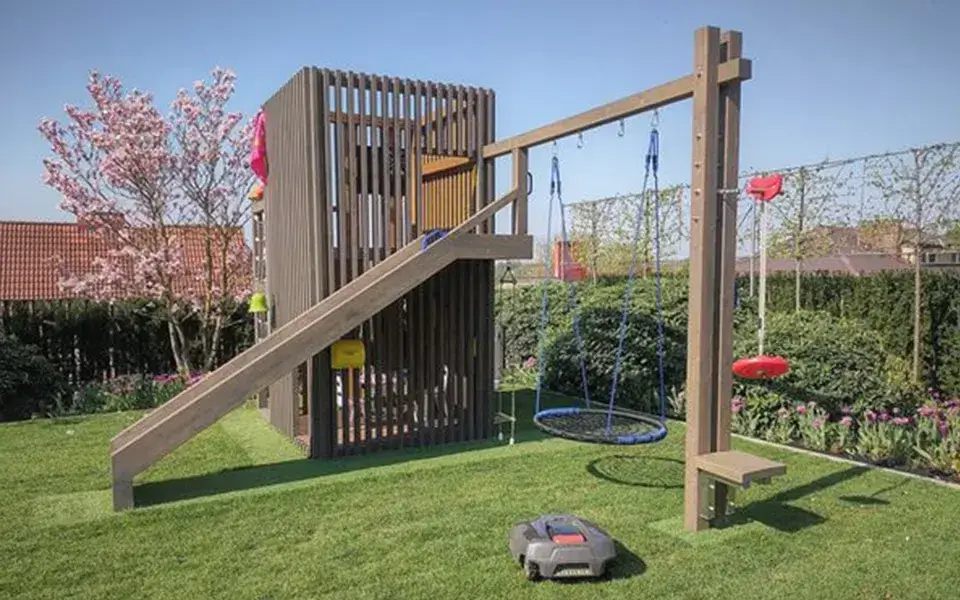
A lawn works well, but it’s worth adding a soft bark path, wooden panels or mats in the spots where children play hardest. That way, the play area fits in with the rest of the garden and gives children a safe, comfortable place to play.
Under a swing or climbing wall, or beside a slide, it’s worth laying an impact-absorbing surface:
- rubber mats,
- artificial grass over a certified shock-absorbing underlay,
- pine bark or washed gravel.
These surfaces help prevent injuries and are easy to keep clean – something that matters when children play outdoors.
How softly a child lands depends on the possible fall height as well as on the type of surfacing. A swing with a low seat needs a thinner layer than a slide platform. The type and depth of the fill are therefore chosen for the highest point of play. The impact-absorbing surface extends beyond the equipment, along the path of the swing and beyond the end of the slide. Bark and washed gravel cushion a fall only if the layer is deep and even. Landing and run-up areas suffer the most wear. The fill is displaced fastest there, eventually exposing hard ground. Artificial grass itself provides no cushioning. The protection comes from the underlay. Rubber mats and underlays need a base that drains, because water pools beneath the surface on compacted ground.

3. A shady spot to relax
Every garden for children needs a quiet spot. After a scramble down the ladder, there’s time for a sip of lemonade in the hammock, a moment in the shade or simply a bit of cloud-watching. Good options include:
- a pergola covered in climbing plants,
- a garden hammock slung between trees,
- a fabric canopy or a garden parasol,
- or even a small tent or teepee.
Add some comfy cushions, mats, a blanket or a child-sized sun lounger to make a cosy corner where children can rest after energetic play.
4. A learning garden – the fun of finding things out
Giving children a patch of garden where they can grow their own plants is more than just fun. They get to take responsibility, understand nature’s rhythms and watch things change. Plant wild strawberries, cherry tomatoes and mint together. Build a bird feeder. Make a home for insects.
Children learn from a garden just by being there, and by getting involved.
5. A garden playhouse at the heart of children’s adventures
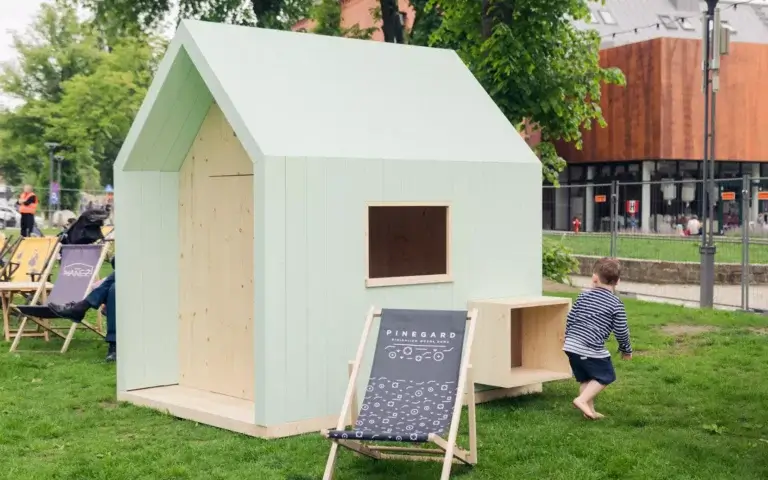
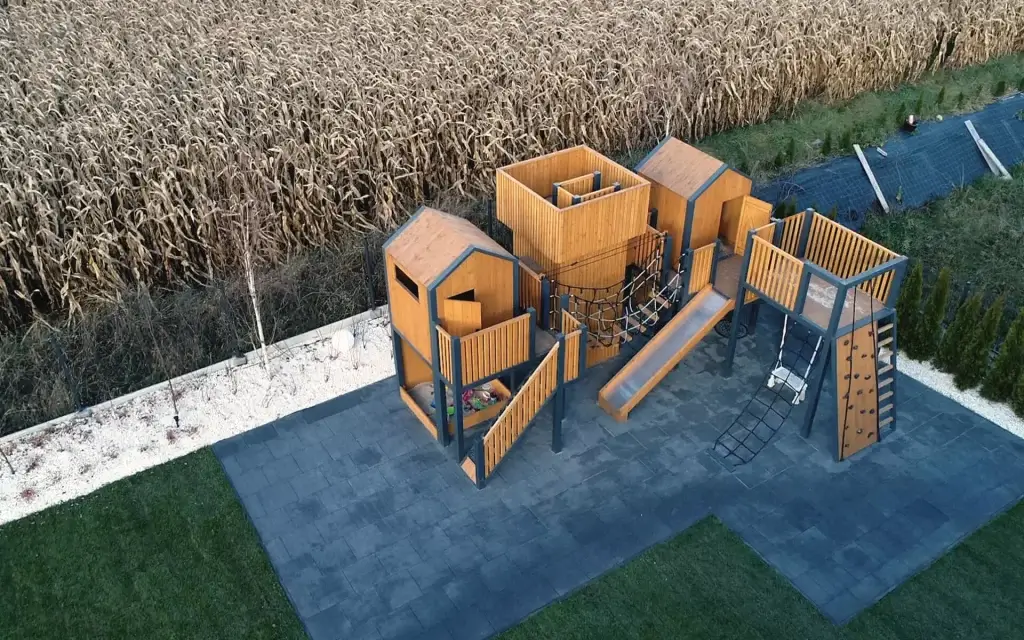
A wooden garden playhouse for children is a childhood classic – and something many adults dream of too. At Pinegard, we help bring that dream to life in style. A playhouse can have one storey or two. It can be minimalist or have a veranda. It can be white, left in its natural wood finish or decorated by the children themselves.
It’s more than a toy. It has a story of its own. A place you keep coming back to when you’re ten, thirteen and then… thirty. It’s worth having one.
Ideas for a garden that grows with your child
The play area can change. You can build on it as your child grows, eventually turning the sandpit into a pitch for ball games and the playhouse into a place to hang out with a daybed and a Bluetooth speaker.
A few ideas for adding variety:
- a climbing wall on the garden fence,
- a suspended obstacle course made of ropes and ladders,
- an outdoor screen for showing cartoons,
- a sensory path made from different materials (stone, wood, sand).

To sum up – a garden for children is a garden with heart
A garden for children is a garden with heart. It needn’t look like a playground from a catalogue. What matters is that it’s somewhere to spend your days together. Somewhere to run barefoot on the grass in the morning, play hide-and-seek and build ships out of cardboard boxes that then sail off into the unknown.
And though children grow up quickly, their memories of the garden stay with them.
At Pinegard, we create spaces that matter. Wooden structures where form meets function and durability goes hand in hand with feeling. Playhouses, pergolas and enclosures that inspire – and grow along with your home.